
Laying in a beautiful field surrounding by flowers in a warm summer night, gazing upon the sparkling stars in the sky with your favourite person is an inherently romantic moment. However, let’s travel a bit deeper into space and look into occurrences that showcase even more romance – and why us humans connect these phenomen with these deep feelings.
The most romantic nebulae in space?
The Valentine’s Nebula or Heart Nebula
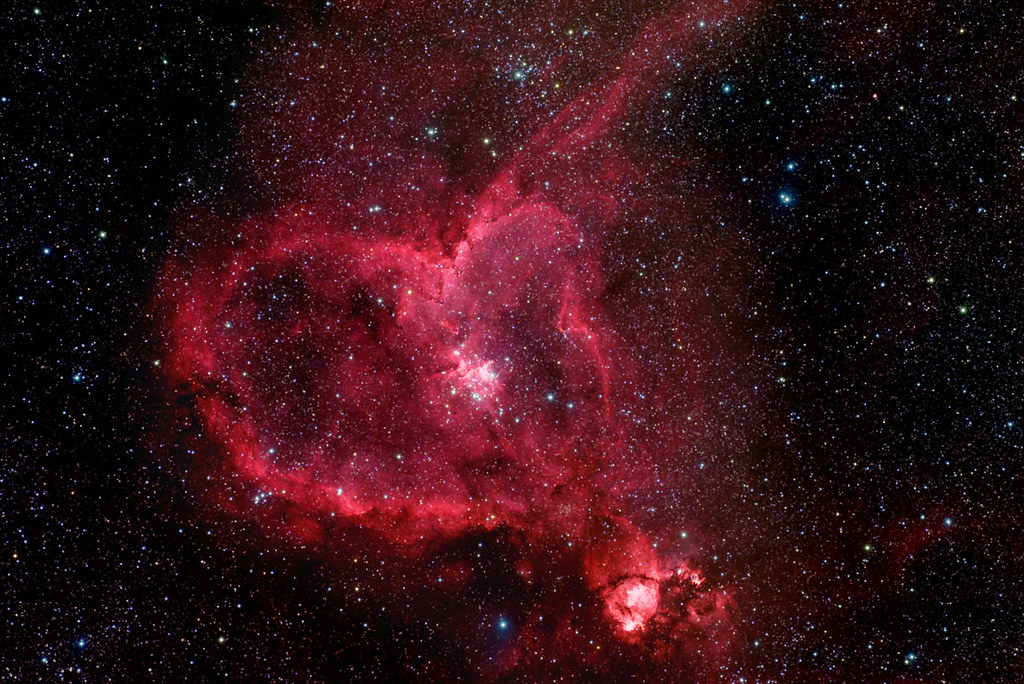
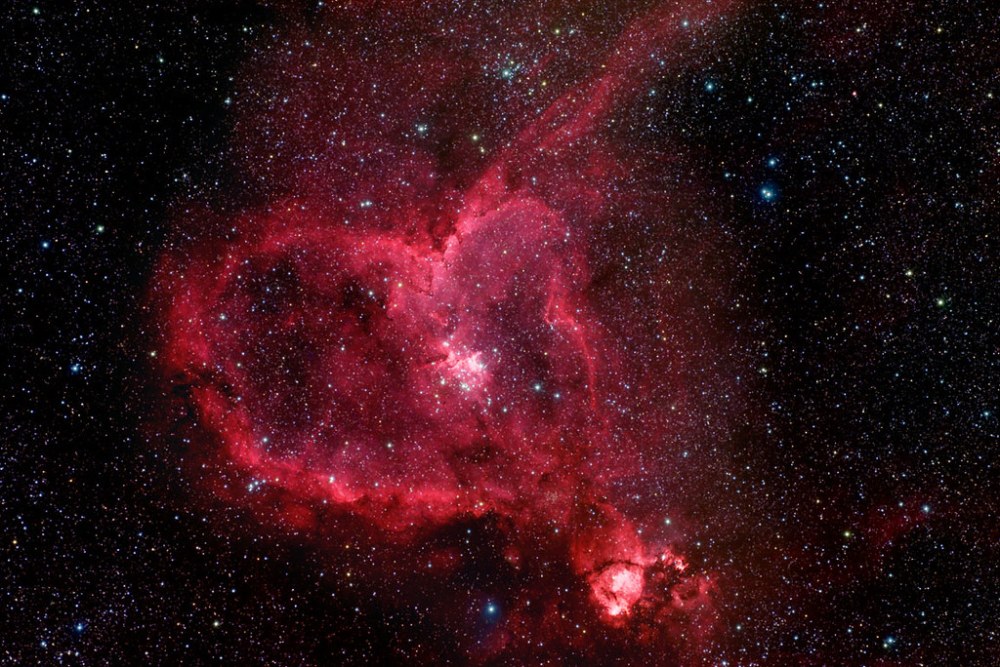
While all nebulae make for a breathtaking view, there are two examples that carry romance within: The Heart Nebula (Valentine’s Nebula) and the Rosette Nebula. The Heart Nebula, also known as IC 1805 (Index Catalogue of Nebulae and Clusters of Stars), is a stunning emission nebula located about 7,500 light-years away in the constellation Cassiopeia. An emission nebula signifies that the cosmic gas that forms the nebula is glowing itself, rather than reflecting starlight which reflecting nebulae do.
Its distinctive heart-shaped appearance is due to the intricate structures of ionized gas and dust, shaped by the stellar winds and radiation from the central open star cluster, Melotte 15. This region of active star formation is illuminated by young and hot stars. To make the view even more poetic, next to the Heart Nebula is the so called Soul Nebula – often photographed together as Heart and Soul.
The Rosette Nebula
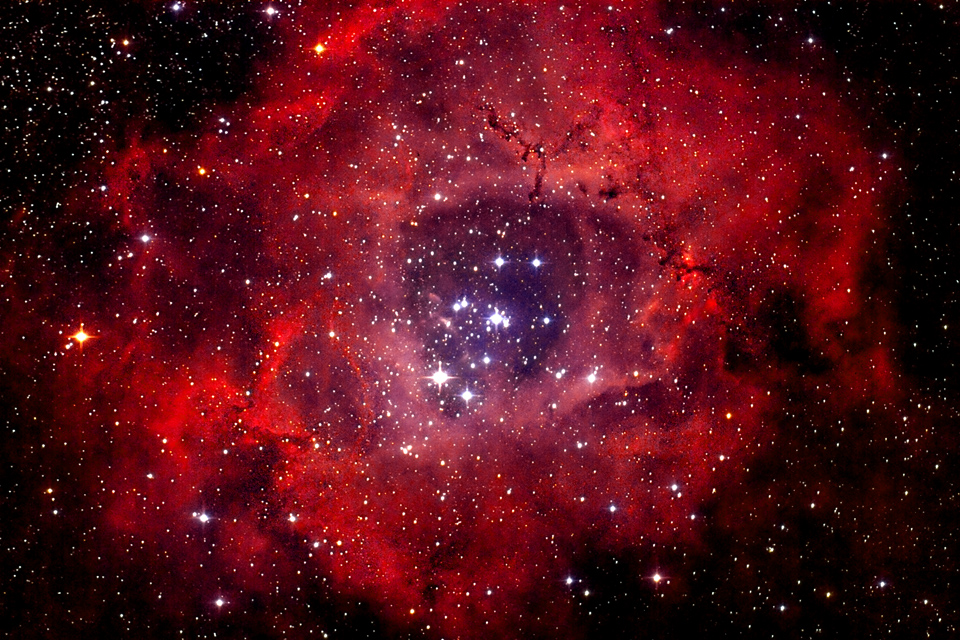
Another romantic view in the vast universe is the Rosette Nebula known as Caldwell 49 and NGC 2237 (sorted in the Caldwell Catalogue for amateur astronomers and the New General Catalogue, a comprehensive astronomical catalogue). This nebula is a large, circular H II region, which is a type of emission nebula where ionized atomic hydrogen gas emits light. It is located in the constellation Monoceros (Unicorn), near the border with the constellation Orion and is approximately 5,000 light-years away from Earth.
At the centre of the Rosette Nebula lies the open star cluster NGC 2244. The young, hot stars in this cluster are responsible for ionizing the surrounding gas and causing it to glow. While some see a beautiful rose in its shape, others make out a human skull in its clouds – not quite as romantic, so let’s got with the flower-version! This rose is not visible for the human eye and can only be seen through a telescope.
Venus: Where love and beauty meet in the cosmos
The planet of femininity
Most people know that the second planet in our solar system, Venus, is named after the Roman goddess of love. But what made our ancestors look up into the sky and decide that this object is the very essence of amour? Especially with our knowledge nowadays of Venus being a volcanic hell with toxic clouds of sulfuric acid, the connection to passionate love seems not based on anything scientific.
The romantic connection is not something that is bound to any physical facts being measured. It is something that comes from experiencing and observing this planet with your own eyes. Venus is the third brightest object for our Earth, after the Sun and moon. Not just its luminosity is beautiful to witness, Venus is also called the Morning Star or the Evening Star, being the first celestial body to become visible in the sky in the evening and the last one to disappear at sunrise. This means that Venus is bathing in the stunning red and pink colours that are painting our sky at dusk and dawn.

With Venus being such a powerful, gorgeous and mythical object to see, it captivated people all around the world as many cultures associated the planet with deities of love, beauty, and fertility.
- Old norse:Blóðstjarna (the bloody star, in relation to the deity Frigg)
- Czech: Krasopaní (Beautiful woman)
- Ancient Greek: Καλλίστη” (Kalliste, the most beautiful)
- Babylonian: Isthar (Queen of Love and Beauty)
- Ancient Greek: Aphrodite (The ancient Roman goddess Venus was known as Aphrodite to the ancient Greeks)
- Sumerian: Inanna (the goddess of love and fertility)
- Ancient Egypt: Ioumoutiri, the morning star, and Ouaiti, the evening star, but sometimes linked to Isis (the goddess of fertility, motherhood, and magic)
- Hindu: Shukra (meaning clear or bright, in Hindu mythology linked to Venus and representing women, beauty and luxury)
Venus is the only planet named after a female god and also most of its features are named after women: areas are named Aphrodite Terra, Ishtar Terra, or Lada Terra for example, Lada being the Slavic Goddess for love.
How to see the planet of love yourself

For many women, Venus strengthens their self-love and their connection with their own femininity. If you haven’t witnessed it yet, make sure to catch a view of Venus basking in all the beauty of the red trenched sky.
Venus is so bright, sometimes you can even see it during daytime. The easiest way to spot the planet is when it is near the moon so it’s easier to navigate and also before sunrise. It outshines every other star, so ideally you go out around 30 minutes before sunrise to easily identify the bright spot. Then follow it throughout sunrise and enjoy your view! You can make it easier for yourself if you locate it near an object, like a building or tree to keep track of it. Venus is always close to the sun from our view, so if you’re in the Northern Hemisphere, you will notice it passing due south in the sky once a day, and if you’re in the Southern Hemisphere, it will be due north once a day.
Keep in mind that due to its orbit, Venus is not visible throughout the entire year from Earth. Your safest bet is to simply download a free app such as Stellarium to know exactly where to look.
The tale of the eternal lover’s stars Altair & Vega
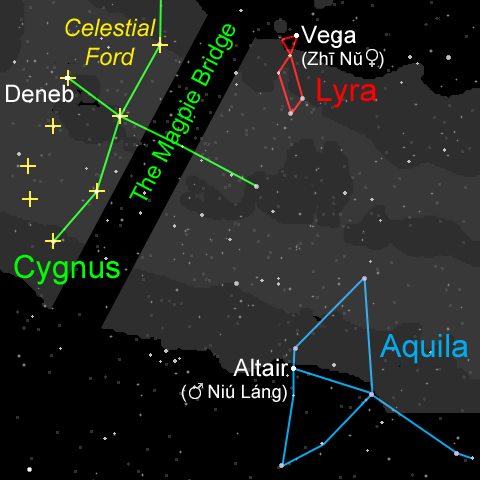
Being in love always involves a second party and there is nothing more romantic than having found your significant other. And it seems like two stars in the night sky have found themselves in just the same way: Altair and Vega are often associated with a romantic tale in various cultures, particularly in East Asian mythology. These are the protagonists of our story:
Altair:
- Designation: Alpha Aquilae
- Constellation: Aquila (the Eagle)
- Distance from Earth: Approximately 16.7 light-years
- Brightness: The 12th brightest star in the night sky
- Characteristics: Altair is a white main-sequence star of spectral type A7V. It rotates very rapidly, causing it to have an oblate shape, meaning it is flattened at the poles.
Vega:
- Designation: Alpha Lyrae
- Constellation: Lyra (the Lyre)
- Distance from Earth: Approximately 25 light-years
- Brightness: The 5th brightest star in the night sky
- Characteristics: Vega is a white main-sequence star of spectral type A0V. It is one of the most studied stars and was the first star other than the Sun to be photographed and have its spectrum recorded.
The Tale of the Cowherd and the Weaver Girl

In Chinese mythology, these two stars are personified as Zhinu (織女; the weaver girl, symbolized by the star Vega) and Niulang (牛郎, symbolized by the star Altair). According to the legend, Niulang and Zhinu fell in love, but their union was forbidden and they got separated by being placed on opposite sides of the heavenly river (the Milky Way). Once a year, on the seventh day of the seventh lunar month (during the Qixi Festival), a bridge of magpies forms across the Milky Way, allowing the lovers to reunite for a single night. The stars Altair and Vega are really visibly separated by the Milky Way in the night sky, and the annual cycle of their visibility aligns with the timing of the festivals.
There are many versions of this story, dating back even 2600 years ago in poems. In ancient times, women make wishes to these two stars Altair during the festival. The story was adopted and adapted by Japanese and Korean cultures, where it became integrated into local traditions and folklore. In Japan, the festival Tanabata involves writing wishes on strips of paper and hanging them on bamboo, while in Korea, Chilseok is celebrated with various rituals and festivities.
A galactic dance resulting in a colliding heart

Once of the most spectacular sights in regards of romance in outer space is the collision of NGC 4038 and NGC 4039, collectively known as the Antennae Galaxies. The two originally separate galaxies perform a cosmic dance in the constellation Corvus, approximately 45-65 million light-years away from Earth. These two spiral galaxies with a supermassive hole in their core each are in the midst of a dramatic collision and merger, a process that stretches over a billion years. Their stars rarely collide, but instead new stars are formed by the gases colliding with each other.
The gravitational interaction between them has twisted their once regular spiral shapes into long, luminous tails of stars, gas, and dust, resembling antennae. Now they form a beautiful shining heart – but the transformation is not yet complete. Eventually they will likely form a massive elliptical galaxy.
The asteroid of love
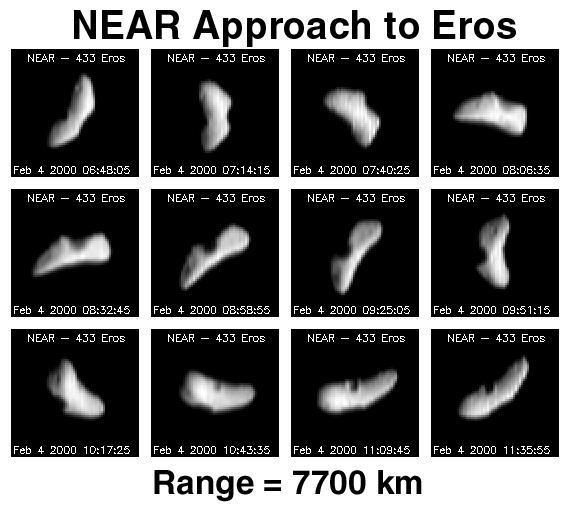
Eros (433 Eros) is an asteroid named after the Greek god of love and one of the largest near-Earth asteroids discovered to date, measuring approximately 34.4 × 11.2 × 11.2 kilometers in size. Asteroids are small rocky objects that orbit the Sun.
Eros was discovered by German astronomer Gustav Witt at the Berlin Observatory on August 13, 1898. The asteroid orbits the Sun in an elongated path that crosses Earth’s orbit, making it potentially hazardous. In 2000, NASA’s Near Earth Asteroid Rendezvous (NEAR) Shoemaker spacecraft made history by becoming the first spacecraft to orbit and land on an asteroid – Eros. And to make things more fitting: this happened on Valentine’s Day!
Astrophilia: The love for space that connects us all!
If you made it to the end of this post, it probably means you have a deep interest in astronomy or want to learn more about this beautiful night sky you enjoy observing. And if you’d agree if someone describes you as loving the planets, stars or outer space, you might as well be an Astrophile – which is the term for someone just like you. So next time you’re watching the night sky, you hopefully have an eye out for the romance that space carries within!


 M16 Nebula
Leave a comment